

Environmental Justice
Chicago’s communities of color have been historically marginalized in a variety of ways, but one of the greatest is the disproportionate burden of pollution they have received from industry and other sources. Here are some resources to learn about the legacy of environmental pollution in Chicago, ways to find out if your neighborhood/home is affected and to protect yourself, and some local organizations you can get involved with.
jump to…
Air Quality
Air
Report an Air Pollution, Odor, or Dust Complaint to the City of Chicago: This 311 request can be submitted to the city if you are observing an air pollution issue.
Submit a Complaint to the Illinois EPA: Submit an air pollution complaint directly through the IEPA website.
Submit an Air Pollution Complaint to N4EJ: Help N4EJ track air pollution issues by visiting smellsbad.today.
Check today’s air quality: Purple offers a live view of all the air quality monitoring it is currently doing in Chicago.
Receive Air Quality Alerts from the Illinois EPA: Sign up to receive email notifications when an Air Quality Action Day is declared.
Ineffective By Choice, A Review of Environmental Enforcement Data in Chicago from 2002-2022 - This damning report highlights the lack of enforcement of pollution laws in the city of Chicago since the dissolution of the Department of the Environment in 2012. It provides data evidence that the division of environmental issues between unrelated city departments has benefited corporate polluters at the expense of Chicago residents.
Midwest Comprehensive Visualization Dashboards: The Image of an Overburdened Community - published by researchers at the University of Illinois at Chicago, these visualizations show that the majority of Chicago’s asphalt plants and rail yard support facilities are on its southwest side. These rail yard support facilities also require especially heavy truck traffic levels to manage the shipments delivered by train cars. This, coupled with the prevailing wind direction in the area, leads to significantly higher air pollution in Pilsen, Little Village, McKinley Park, and the surrounding areas.
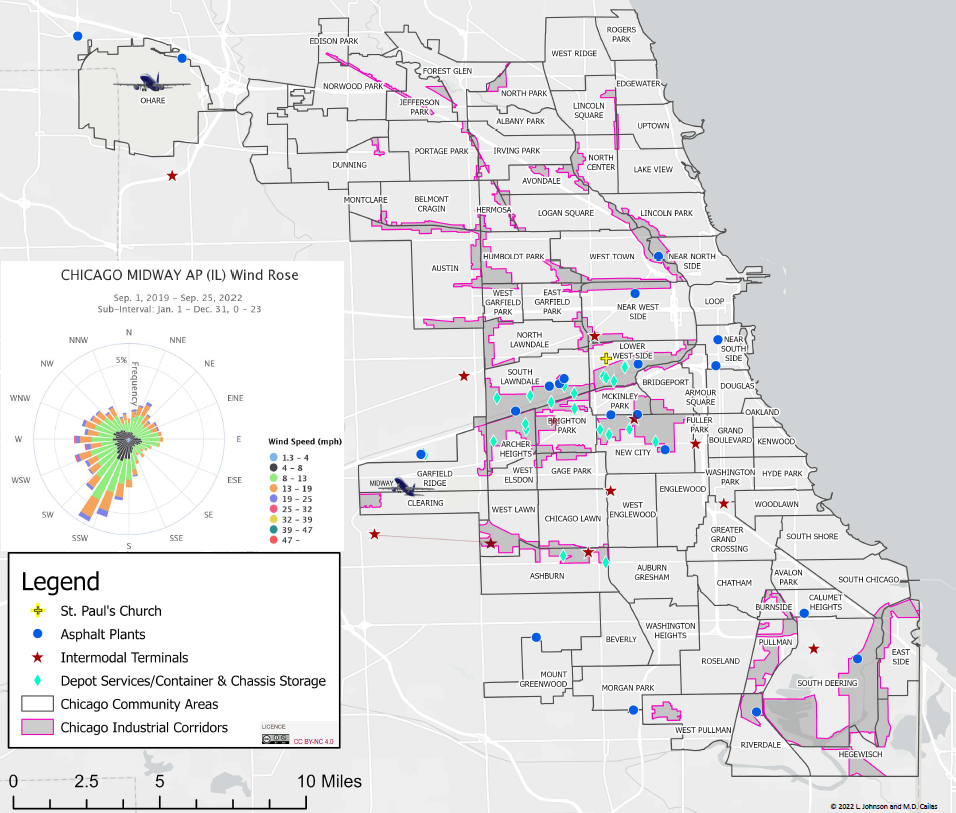
Image from Midwest Comprehensive Visualization Dashboards: The Image of an Overburdened Community. Image credit to L. Johnson and M. Cailas, via UIC. Full text and graphics can be found HERE.
Water Quality
Illinois has more water pipes made of lead than any other state. There is no amount of lead that is safe in our drinking and household water, and the effects of lead poisoning are extremely damaging, especially to children. Black and brown neighborhoods are significantly more likely to still have lead piping and greater exposure to water contamination. Here are some resources for you to take action in your own home:
Check whether your home has lead pipes with this impressive map made by WBEZ, Grist, and Inside Climate News.
Water Lead Test (FREE) - Find out if the water in your home is affected by lead poisoning through a simple 311 request.
Report Spills or Dumping in a Natural Waterway- (311 request)
Report a Water Quality Concern - Through this request, you can make an appointment to speak with a person from the Division of Water Quality, and they may even come to your house to take samples (if required).
Water Filters for Eligible Homes (FREE) - If your home is in a specific area with known lead contamination, you may be eligible for a free lead water filter.
Soil Quality
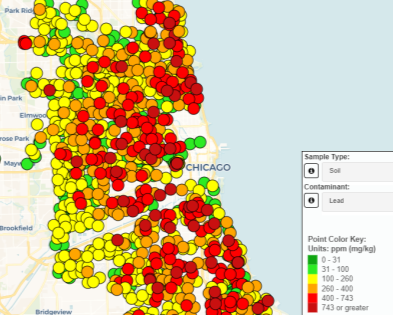
Credit: University of Illinois Extension
Elevated levels of heavy metals in soil are rampant across Chicago.
Urban Soil Information - This article describes the lead contamination problem in Chicago soil, and what can be done to test the soil in your area.
Cook County Farm Bureau - Kits are not free but members get a discount on prices ($30-$58 for members and $40-$68 for non-members)
University of Wisconsin-Madison - Kits are $30 per sample, can pay extra for additional testing and UW Soil and Forage Lab does not test for lead
Green Alleys: Green Alleys offer one way to improve drainage in your neighborhood. Visit the link to learn more about the city’s Green Alley program, and how you can get one for your ward.
Green Alley Equity: This article covers some issues with inequitable green alley placement in our city.
Report Water on the Street to 311: One way to address drainage issues is to report it to the city so they can clear the drains if possible.
City of Chicago’s Green Infrastructure Plan (2026): This document summarizes Chicago’s strategy to reduce urban flooding across the city. It includes 23 key stakeholders who are supporting the need to address this issue, which is a result of climate change.
Chicago Flood Sensor Program: In 2025, Chicago piloted a flood sensor program across the city, in hopes of gathering more data to reduce our flooding issue. Learn more at the link.
Green Values Stormwater Management Calculator: This tool from the Center for Neighborhood Technology will help you evaluate the benefits of green infrastructure to prevent urban flooding.
Urban Flooding: Guidance for Homeowners and Renters (2024): Cook County, IL, Flooding Mitigation Assessment Team Guidance Document created by FEMA
Water Barrels: A water barrel, also known as a rain barrel, is used to catch and store rainwater runoff, usually from a building's roof routed via the gutter system. Having a barrel could allow you to conserve water, reduce your utility bills, and provide plants with chemical-free irrigation water. They also reduce flooding on your property and street. MWRD offers them at a low cost for Chicagoland residents. Learn more about the MWRD Water Barrel Purchase Program HERE.
Interested in how water management works? You can book a demonstration tour of the MWRD! (Metropolitan Water Reclamation District of Greater Chicago) Resource: https://mwrd.org/education/community-engagement
Urban Flooding
Environmental Justice Organizations
Alliance of the Southeast (ASE) - ASE is a multicultural, interfaith coalition of churches, schools, businesses, and community organizations, all working together to address the challenges facing the neighborhoods of Southeast Chicago. Formerly the Alianza Leadership Institute, they have grown from their beginnings as series of leadership skills workshops to a powerful network with over 40 community partners representing thousands of people.
BIG: Blacks in Green - BIG is an environmental justice and economic development nonprofit in the West Woodlawn community. BIG is the creator of the Sustainable Square Mile™ – a whole-system solution for the problem common to Black communities. It is considered the gold standard for Black community economic development, where families can walk to work, shop, learn, play, and live the conservation lifestyle. Some of their projects include the Campaign to End Energy Poverty, Garden-Oriented Development (GOD), and the conversion of the Emmett Till & Mamie Till-Mobley House into a Museum.
Chicago Asian Americans for Environmental Justice (CAAEJ) - is a group of progressive Asian Americans in the greater Chicagoland area working to provide an Asian American voice in the environmental movement and center the people impacted by environmental injustice. In addition to engaging and educating Asian Americans on local and national environmental justice issues, they mobilize their community to stand in solidarity with other organizations doing this work in Chicago and beyond.
Chicago Center for Health and Environment (CACHET) - CACHET was established to address dramatic racial/ethnic health disparities prevalent in the Chicago area for multiple diseases and outcomes. CACHET’s main focus groups include Air, Water, and Soil Pollutants, Biomarkers of Exposure, Effect, and Susceptibility (BEES), and Molecular and Cellular Processes on Environmental Toxicity (McPET).
Chicago Environmental Justice Network (CEJN) - The Chicago Environmental Justice Network is a network of allied environmental justice organizations working to change systems and build power through transformative campaigns, policy advocacy, and community-based education. It is also a collaborative hub for environmental justice organizations to develop and share movement strategies, resources, and experiences.
Faith in Place - Faith in Place empowers people of diverse faiths and spiritualities in Illinois, Indiana, and Wisconsin to be leaders in advancing environmental and racial justice, providing resources to educate, connect, and advocate for healthier communities. They implement programs in five areas – Climate Change & Energy, Sustainable Food & Land Use, Water Preservation, Advocacy, and Youth Empowerment. They also help start and support Green Teams, which are groups of 3 or more people from a house of worship who provide cooperative leadership to educate and advocate for healthier communities.

Little Village Environmental Justice Organization (LVEJO) - The mission of LVEJO is to organize with the Little Village community to accomplish environmental justice and achieve the self-determination of immigrant, low-income, and working-class families. Their vision is to build a sustainable community that promotes the healthy development of youth and families, provides economic justice, and practices participatory democracy and self-determination. Building upon the successful clean power, public transit, and open space campaigns, LVEJO remains committed to organizing with those most impacted by industrialization and climate change.

Neighbors for Environmental Justice (N4EJ) - The purpose of Neighbors for Environmental Justice is to educate, advocate and organize with their community to accomplish environmental justice on the southwest side of Chicago. They believe environmental justice cannot be separated from racial justice, and so they align and advocate to support the larger struggle for justice in all the forms it takes.
People for Community Recovery (PCR) - People for Community Recovery was founded in 1979 by visionary leader Hazel Johnson, who is widely considered to be the mother of environmental justice. PCR’s mission is to enhance the quality of life of residents living in communities affected by environmental pollution. They advocate, educate, and organize on community-identified priorities including environmental and climate justice, safe and affordable housing, economic equity and community health.
Pilsen Environmental Rights and Reform Organization (PERRO) - PERRO is a volunteer-led, grassroots community group of Pilsen residents that formed in 2004 to fight the disproportionate amount of pollution in the Pilsen neighborhood. PERRO informs residents about the health dangers of pollution from all sources in Pilsen and works with the city departments, the EPA, and elected officials at all levels to develop a solution to reduce pollution to make Pilsen a cleaner place to live, work, and breathe. You can check out their current campaigns here, including several against major polluters on the southwest side.
Southeast Environmental Task Force - Southeast Environmental Task Force is a non-profit organization dedicated to mitigating environmental racism seen on Chicago’s Southeast Side and Calumet Region. The fight for clean air, water and environmental justice is a service that benefits everyone. The group works tirelessly in order to bring about fundamental change for Chicago’s residents in historically disenfranchised Black and Brown neighborhoods.
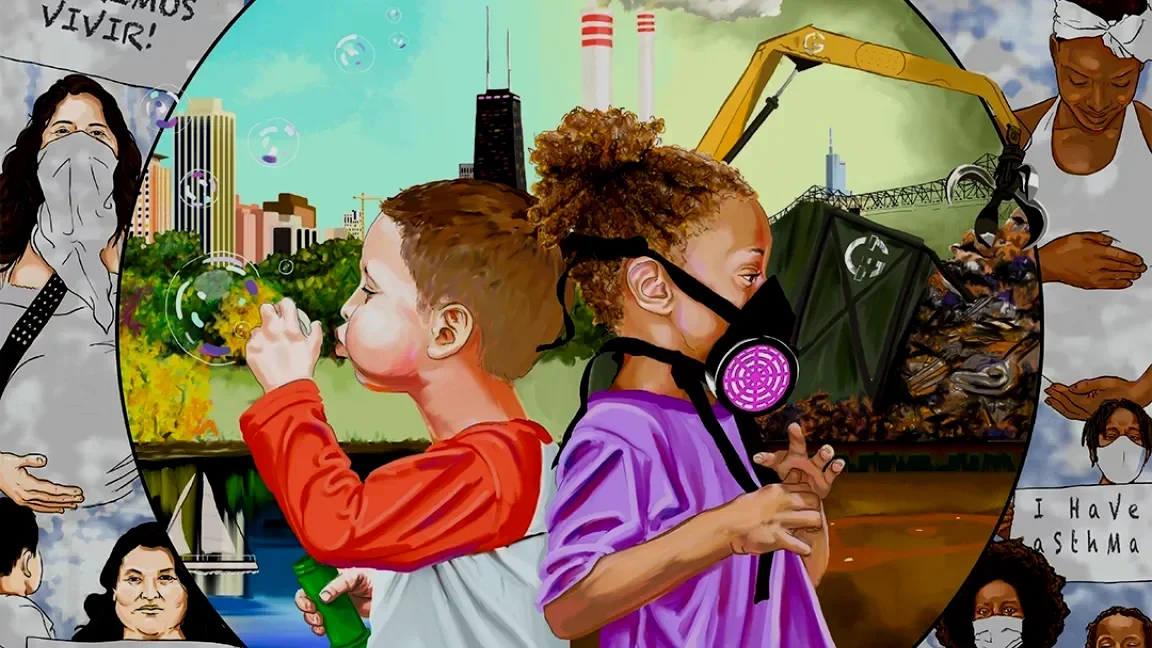
Banner Art Credit: Provoke Culture x Sergio Maciel for Patagonia Chicago and NRDC. @sergmaciel @provokeculture